



- Русский
- English
- Português
How to Create a Design Project Using AI: A Real, No-Frills Guide

You know how it usually goes? You Google something specific, get miles of text—half of which is fluff—and the answer you need is buried somewhere at the end. It's the same story with interior design via AI. Previously, this whole process dragged on for months: hire a designer, approve sketches, wait for the visualization. Now, the entire process takes literally a couple of days. And that’s a fact.
“Over 8 years, I’ve assembled dozens of teams—more than 50 people launching projects from scratch. The conclusion is simple: if a task can be automated via AI, don’t waste time on hiring.” We implemented a cryptocurrency arbitrage service absolutely without in-house programmers—exclusively through NoCode and neural networks. With design, it's the same: the right prompt saves weeks of time.
Introduction to AI in Interior Design
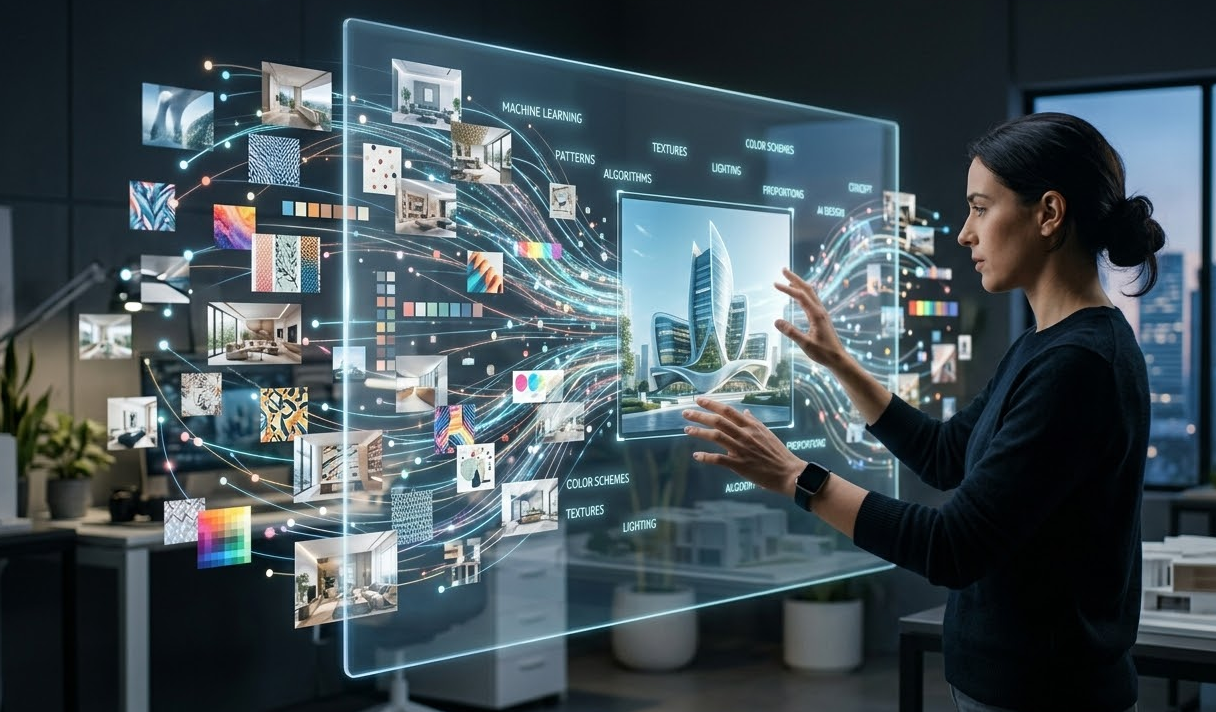
AI for design is actually just a crowd of machine learning algorithms that have artificially processed millions of projects, styles, and color schemes. And now, it can give you a new concept in a second. Neural networks like Midjourney or Stable Diffusion were trained on such a vast amount of visuals that they know how to correctly combine textures, where the light should fall, and what proportions work.
The market for AI solutions in architecture is growing—by 2026, it will reach $1.7 billion.
What’s important: AI often suggests an option a human wouldn't think of. It mixes styles from different eras and different cultures, resulting in something fresh. In modern design, it’s a kind of high-speed analyst that instantly produces dozens of ideas based on your brief. Sketches used to take a week; now they take one evening.
Overview of Design Automation Technologies
Today, three main technologies work in interior design. The first is generative neural networks (Midjourney, DALL-E, Stable Diffusion): they draw images based on a text description. The second is parametric modeling (Autodesk Generative Design, Grasshopper): it optimizes the placement of objects, taking physics and ergonomics into account. The third consists of constructor platforms (Planner 5D, RoomGPT): they offer a simple interface where you can realize a project without 3D skills.
Practical examples? Zaha Hadid Architects shape their facades using parametric algorithms to minimize structural load. The startup Modsy automatically arranges furniture based on room photos. Designers in Dubai get renders in 5 minutes via Midjourney instead of spending hours in 3ds Max.
On our platform ASCN.AI, we have created an ecosystem of NoCode tools consisting of many modern artificial intelligence technologies. Everything is launched via an AI-powered agent chatbot. It will collect references, generate a layout, select a palette, and form a concept, which it immediately sends via Telegram. No designers, no months of waiting. A prompt + 10 minutes, and the project is ready.
Advantages of Using AI for Interior Design
Thanks to AI, project development is accelerated 5-10 times relative to the traditional approach. If previously the entire cycle—measurements, sketches, approvals, 3D visualization, revisions—"ate up" 2-4 weeks, with AI, the first 10 options are delivered in 2-3 days. The process has clearly become much faster.
Previously, a designer might spend up to 40 hours on a manually executed concept; now, AI does the bulk of the work in 2 hours of human-assisted operation.
At ASCN.AI, we had a project where we automated the preparation of design concepts for a crypto agency. Before: $500 and a week of work. Now: one evening and zero expenditure on contractors. The savings amount to 20,000 rubles per month.
Personalization and Creativity with AI
AI generates unique solutions for your specific task. You describe the design style itself (e.g., South Japanese minimalism and radical loft), the room parameters and its elements (25 square meters, ceiling height, panoramic windows), as well as the mood that should prevail in it (calm and focused), and you end up with an original product that no one else has.
The Interior AI service allows users to upload photos of an interior and receive five options in various styles—Scandinavian, mid-century modern, eco-style—based on it. This allowed for a 22% increase in order conversions. Havenly utilizes GPT and conducts user preference analysis via a chatbot to automatically select palettes, furniture, and decor.
We had an office project in a "cyberpunk + natural materials" style: in 10 days, using Midjourney, we drew 15 concepts with neon and wood, chose the best one, and refined it, instead of working the standard month.
Key Tools and Platforms for AI Design Project Generation
- Midjourney — a generative neural network within the Discord messenger. Subscription starts at $10/month. It produces photorealistic interior renders and supports complex queries, though it lacks a built-in editor.
- Planner 5D — a constructor with built-in AI; it has a free version, while premium costs $10/month. Features auto-arrangement of furniture, 3D and VR output, but customization is limited.
- Autodesk Generative Design — a specialized parametric engine for professionals; it is part of Fusion 360 ($495/year), accounts for physics, loads, and insolation, integrates with CAD, and requires special training.
- RoomGPT — a completely free web service powered by GPT-4 Vision, allowing you to redesign rooms based on photos in 30 seconds; the quality is average, with 5 free requests per day.
- ASCN.AI NoCode + AI Agents — a tailored automation platform connecting Midjourney API, GPT analysis, Telegram leads, and Google Sheets. Subscription price starts at $29/month.
If you just need a beautiful picture—take Midjourney. For furniture arrangement and 3D—Planner 5D. If you need to solve a complex commercial task with engineering calculations—Autodesk. And to assemble an auto-flow from lead to finished design without a single line of code—you need ASCN.AI.
Step-by-Step Guide to Creating a Design Project Using AI
The main thing is a clear and complete brief. AI cannot read minds, so the clearer the input data, the better the result. It is necessary to designate the functions of the given room (e.g., bedroom, office), its dimensions (area, ceiling height), the location of windows and doors, the design style, color preferences, cost (budget), and technical constraints (e.g., walls cannot be demolished).
Don't forget to photograph all angles, measure all important parameters, and record them in a table. Collect references on Pinterest, Houzz, or Instagram. The more thorough the preparation, the easier the work.
Brief example:
- Type: room for meeting friends
- Area: 18 m²
- Windows: one, south-facing
- Style: Japanese minimalism and wabi-sabi
- Colors: beige, grey, black
- Furniture: low sofa, coffee table
- Budget: 300 thousand rubles including renovation
- Constraints: radiator cannot be removed
In ASCN.AI, the capabilities for collecting a brief using AI are automated: the Telegram bot receives a structured JSON format of the brief, which will later be used during project generation.
Data Processing and Design Option Generation
Next comes the most interesting part: the brief turns into a prompt, and the neural network produces the first design options:
Japanese minimalism living room, 18 sqm, beige and grey tones, low furniture, wabi-sabi accents, large south-facing window, natural light, warm atmosphere, photorealistic render --ar 16:9 --v 6
Creation takes about 30 seconds. You get several options of varying execution quality. You choose the most successful one, refine it, and create multiple variations from it with adjustments. Usually, the final product can be obtained in 5–7 iterations.
In the event that you use the Planner 5D system, you only need to set the room dimensions, then turn on the AI mode and choose one of the ready-made styles. Next, the furniture is placed automatically, and then you can refine the details and export to 3D.
In the ASCN.AI system, artificial intelligence is capable of automating the entire process without human factors: from the brief created in the convenient Telegram messenger to the two best options sent to the client via email, obtained from the GPT Vision system and the Midjourney API.
Editing and Refining the Project Using AI
At the same time, it must be taken into account that an AI render is just a preliminary layer, without considering exact dimensions, socket locations, or building codes. To combine the image with a piece of the floor plan in AutoCAD, SketchUp, or Google Drawings—you need to check the clearance for the nice furniture and consider, in any case, where the doors open, and so on.
AI will handle the rough work, but technical nuances still need to be checked manually. For example, check ergonomics based on the work triangle criterion, countertop dimensions, and access to power outlets.
Adobe Photoshop (for retouching renders), Figma (mood boards), and SketchUp (drawings) are excellent for refinement.
In ASCN.AI, AI Agents investigate projects for compliance with GOST and SNiP (building standards):
“The distance from the stove to the sink is 40 cm—less than the recommended 60 cm, high risk of splashes on the stove.”
This makes design faster and more reliable, as hours of manual checking are reduced.
Cases and Examples of Successful AI-Assisted Design Projects
Case 1: Apartment Redesign in 3 Days Instead of 1 Month
The client had an urgent task to quickly transform a two-room apartment in Moscow for rent. For 80,000 rubles and a month of work, designers couldn't do it. And that's where ASCN.AI helped. The brief was collected by AI in Telegram, 12 options were generated in Midjourney, 3 of which were chosen as the best, processed in Planner 5D, and a furniture list was compiled. In the end, in 3 days and for $69 in subscriptions, a finished set was obtained, saving 78,000 rubles and 25 days of time. The apartment was rented out 2 days after publication.
Case 2: Cyberpunk + Eco Style Office for a Crypto Startup
Order: combine neon cyberpunk and natural materials in an office in Dubai. Three studios said "no." The fourth asked for $15k and a 6-week timeframe. ASCN.AI with artificial intelligences generated 20 variations with prompts like "cyberpunk office interior, neon lighting, natural wood panels." We chose the best 5, added lighting, and prepared specifications. The concept was ready in 10 days and accepted on the first try; implementation took another 3 weeks. The total design cost was $500. Investors became interested in the project.
Case 3: Personalized Layouts for a Developer
The developer of a high-end residential complex offered only 3 standard finishes; the conversion rate was only 12%. We implemented an AI service based on RoomGPT and Planner 5D: the buyer fills out a questionnaire and receives 3 unique layout options in 5 minutes. The conversion rate rose to 19%, and the average check increased by 8%. Within a couple of months, 50–100 leads per month are being processed automatically.
The conclusion is simple: AI reduces development time and costs by 5–10 times, increases personalization, and frees humans from routine manual labor.
Limitations and Challenges in Using AI in Interior Design
AI can create visually clear, effective, and even original images; however, it does not always account for physics. There is a chance it will generate a sofa that won't fit through the doorway or place a pendant light where the ceiling height is only 1.5 m, even though at least 2.2 m is required. AI does not take into account load-bearing structures, utilities, or building codes like SNiP 31-06 or GOST standards for walkways.
Therefore, it is preferable to use AI at the creative stage and conduct technical checks manually or in CAD systems—measuring, consulting with engineers, and checking dimensions and safety.
Formulating prompts is a delicate matter. A vague query ("beautiful living room") is a question with a random answer. It’s easier for beginners to work with libraries of ready-made prompts.
AI occasionally has types of artifacts in its arsenal—extra fingers on hands, incorrect perspective, unnatural light. To clean up the image, 10-20 generations are usually made, followed by retouching in Photoshop. This is still cheaper and faster than creating a 3D model manually.
Ethical and Legal Aspects
According to Article 1228 of the Civil Code of the Russian Federation, the copyright for a work in Russia belongs to a human. AI-generated images are not directly protected by law, but if you have significantly refined the material, you can claim authorship. It is strategically important not to pass off works with borrowed elements from famous designers as your own; otherwise, it is plagiarism.
Legal risks are reduced significantly if contracts specify that visualizations were made using AI. This makes it impossible to bring claims about copying. Midjourney allows commercial use of its images provided a paid subscription is active.
The AI Act is already being prepared in Europe, requiring content created by AI to be labeled. There are no such rules in Russia yet, but development should be monitored.
Frequently Asked Questions (FAQ)
How to choose an AI tool for interior design?
The choice of tool depends on the task at hand and your level of training. For presentations—Midjourney ($10/mo); for layouts—Planner 5D (there is a free plan); for commercial objects with engineering calculations—Autodesk Generative Design (from $495/year and specialized knowledge); and for full process automation—the ASCN.AI NoCode platform.
How plausible and accurate are AI-realized projects?
Starting with Midjourney v6, their visualization has become increasingly photorealistic, but in technical terms, the accuracy is significantly lower and requires verification. By clarifying dimensions, checking ergonomics, and consulting with engineers, accuracy can be brought up to 80%.
Can you unconditionally trust design to AI?
No, you cannot. Artificial intelligence is a great tool for starting the creative process and generating ideas, but the final elaboration—ergonomics, estimates, approvals, etc.—still requires human involvement. Good practice is to use AI agents for routine, domestic, mechanistic moments, and handle strategic issues yourself.
Conclusion and Future Outlook of AI in Interior Design
In 3–5 years, neural networks will be able not only to draw but also to compile working drawings, specifications, estimates, and even 3D models for printing. Already today, NVIDIA Omniverse allows for the creation of interactive digital twins of rooms, meaning you can walk through them virtually and instantly change the finish.
The integration of AI with BIM will make design an entire process—from the foundation to the furniture. Generative design will offer several dozen options at once, taking all constraints into account, and the architect will only choose the optimal variant.
Personalization will reach the level of individual design based on the analysis of predispositions through DNA, social networks, purchases, and biometrics—to create an interior that is as comfortable as possible specifically for you.
At ASCN.AI, we are creating an ecosystem in which anyone without IT skills can launch AI projects via chat. Today it works in crypto; tomorrow it will be in design and marketing. Automation with AI agents is changing markets and optimizing entire departments.
Disclaimer
The information in this article is of a general nature and does not replace investment, legal, or security consultations. The use of AI assistants requires a conscious approach and an understanding of the functions of specific platforms.