



- Русский
- English
- Português
Neural Networks for Sales Proposals: How AI Automates Sales and Drives Conversions

The worth of a salesperson’s skills can be determined based on their ability to facilitate a connection between a client and a cold/professional/tactical selling machine (like a robot) so that the client feels like they are speaking to a person who is actually concerned about their needs and passions, and not just getting the same basic template offer (that is common practice) as everyone else.
I have witnessed multiple companies go out of business solely because they could not get a simple CP out of a time-sucking limbo that lasted more than a few weeks after sending, and therefore (worst-case-scenario), the managers of said companies used the same email template as everyone else for each of the CP's sent to potential customers at the same time, leading to massive creation of non-trust and zero revenues.
Everything is changing; businesses are now in the process of being "turned upside down" because of the fact that the selling process is being "accelerated" as opposed to just being sped up.
"Over three years we tested and developed 43 different methods of automating sales through AI, which led to the following conclusion – an AI neural network does not replace an account manager; rather, it helps to eliminate the redundancy of the account manager's daily routine. We implemented AI agents (to generate CPs) in many of the organisations we worked with and, as a result, they were able to reduce CP preparation time from 2 hours to 12 minutes. In addition, we achieved an increase in negotiating rates of 28%."
Googling "CP templates" is a thing of the past, and businesses are now implementing adaptive databases and business systems to gather data about their customers in order to build a better database of CP templates tailored to each of their customers, in just seconds using the same technology.
What is an AI Neural Network for CPs, and how do they create value for businesses?
An AI for CPs is essentially a database of business knowledge/CPs based on LLM and when you input the data about your product, the platform will generate an appropriate type/format of CP based on the data you have inputted about your customer's pain points, your product, and what is going on in the market. The platform is designed to analyze content based on the description of the service being requested, perceived limitations posed by the client (i.e., fear), and the USP (unique selling proposition) of the service. It is capable of delivering a complete draft in a matter of seconds (10-20) from when you submit your request.
At the foundation of this process are models, such as GPT-4, Claude 3.5, or YandexGPT. These models have been trained on terabytes of text, from marketing articles and business correspondence to successful case studies. A model will build a framework for your deliverable (the product of the process) based on your prompt. The model will build the deliverable in the proper format, including an effective title and an effective call to action, provided you feed it an example of the tone and vernacular that the service you're requesting uses.
Adaptability is one of the most significant features of AI in generating marketing content. For example, if a client had stated that they have low conversion rates on their landing page, the AI will be programmed to provide a suggestion to the client that puts your service in the light of resolving their issue. Or if a client were to receive an introductory email via cold outreach that had to do with B2B, the AI would automatically adapt to the appropriate level of formality, with a focus on ROI (return on investment) for the client, eliminating any non-value-added material to the proposed service.
How a neural network works when generating a CP
The generation process of a CP (content proposal) can be illustrated through the use of a funnel, as shown below:
- Input - You provide the service description, client information, and pain points of the client.
- Context analysis - The AI will create a structure to organize the information (offer, USP, case study(s), call to action).
- Generating text - The AI will use one of several predetermined formulas to create a draft (e.g., AIDA or PAS).
- Verification - A manager will review the draft for errors, make edits, etc.
- Sending - After the above steps are completed, send the final proposal to the client.
Generation mechanics: from dry facts to a persuasive offer
As an example: Produce a commercial proposal for technology companies with $50M revenues. Seeking contractor for lead automation. Use a business-like tone and a standard length of 1.5 pages.
In 10 - 20 seconds, the title, the description of the problem, the description of the solution, the benefits section, the numbers section, and the call-to-action will be prepared by the AI. You will then take over as the author with human review. Fact-check. Verify all numbers/classifications. Anything you change should be adjusted to conform to your writing style and you will send it to the client.
"AI workflow automation with a neural network provides an 89% error rate for all approvals completed at least 5 times faster."
Important to note: AI does not understand your company's inner workings. When using an AI neural network you must provide the region (ex CIS) to eliminate the risk of error. Neural networks will often use U.S. currency in their response and refer to California laws, where applicable. Proceed with caution.
Overview of instructional steps:
- Step 1: Gather data related to product specifications and company
- Step 2: Write a prompt using the role, context & task
- Step 3: Wait for final draft created by AI
- Step 4: Check the facts and have a managing partner review/accept edits
- Step 5: Create and submit final response to client
Key advantages of using neural networks for commercial proposal
Using manual processes to create a commercial proposal for a technology company takes 1 to 3 hours. Collecting the needed data, customizing the selected template to conform to company standards, proofreading the proposal, finding collaborators to finalize and submit a completed proposal to the client takes approximately 15 to 30 minutes with the use of a neural network; therefore, spending less time typing will result in more time to create content for the complete response to your clients.
Another advantage is the ability to create mass amounts of individualized proposals. Neural network producing 50 different proposals at one time. Neural network creates cash register integration proposals for retail and industry about ROI for software as a service. Human will not produce as many high-quality proposals in this same timeframe.
Another advantage of using neural network technology is that it produces writing in a consistent style. When multiple individuals are involved in writing one proposal, the writing styles of the individuals can vary greatly (formal to informal, etc.) or there may be very little benefit highlighted in the proposal. Neural network technology provides consistency in writing style and has demonstrated an 87% decrease in typographical errors compared to written proposals on paper.
Another advantage of using neural network technology is testing. You can create five different headlines and run a small test to test them to determine which is the best. Prior to this, the action would have cost a lot but now it is affordable for anyone.
Another advantage is scaling. If you were sending out 100 proposals per week, you could do that without hiring eight more people. By using neural network technology, the number of proposals created by your current employees can increase four to eight times.
Another benefit is motivation. Many people do not enjoy writing repetitive emails and find it tedious to do it day after day. By letting the neural network create a draft, a manager will have time to negotiate, close, or upsell.
Efficiency Examples: Speed vs. Quality
Ex.1 Retail: Increased the conversion rate of the Company from 8% to 10.8% with Initial Proposals and 35% with Personalization
The company sent out 200 templated proposals every month and achieved an 8% conversion rate before laptops were delivered with personalization. After the introduction of individualized (personalized) proposals, the Company achieved a conversion rate of 10.8% based on region and assortment. The number of meetings created as a result of the 35% increase in the conversion rate was 21, closing 9 deals (4.2 million roubles) in three months, while the average time to create each email decreased by 1.5 hours to 18 minutes.
Ex.2 Software as a Service (SaaS): Shrinking proposal development time from three hours down to twenty minutes.
A B2B platform vendor was collecting data manually and computing pricing for each email with proposal development. The amount of time taken to create an email proposal was approximately three hours. Using a GPT-4 based AI agent integrated with pricing lists, the amount of time spent developing the proposals was reduced to twenty minutes. The proposal includes structured text that includes the relevant pricing details.
The Seven Best Neural Networks to Generate Commercial Proposals in 2026
There is a significant amount of opportunity in this sector. We have identified seven solutions that are functional in the Russian language with B2B and B2C decently without requiring any coding skills. We reviewed the capability, speed, and price of each.
1. ChatGPT (GPT-4o)
This is the overall best solution available from OpenAI. ChatGPT (GPT-4o) is the best logical reasoner available. The context window is 128,000 tokens, allowing users to upload large documents for consideration. ChatGPT (GPT-4o) understands very complex instructions.

Killer feature for CP's: within this solution is that documents can be uploaded. If a user uploads a PDF with a pricing list, ChatGPT (GPT-4o) will create a CP with the actual pricing extracted from the PDF, without making up any of the pricing figures.
Pricing: Free (limited features), GPT-Plus $20.00/month, or API.
Cons: The user interface is occasionally difficult for Russian-speaking customers and does provide some level of "hallucination." For businesses, there are companies that are creating a dedicated AI assistant built on its API.
2. YandexGPT (Yandex Cloud)
Yandex is a competitor of OpenAI and has trained YandexGPT using Russian data; therefore, the vocabulary will feel more natural and suitable for usage within the Russian market. Additionally, YandexGPT is integrated into the Yandex ecosystem.
Killer feature for CP's: within this solution is that YandexGPT can interpret local context; therefore, using "Mr. Ivanov" instead of "Dear Ivan Ivanovich Ivanov" based on current social and cultural norms.
Pricing: Starting at 0.4 rubles per 1000 tokens with a free introductory account.
Cons: YandexGPT is less capable than ChatGPT (GPT-4o) with complex logical statements.
3. Claude (Anthropic) 3.5 Sonnet
It is one of the most popular copywriters with increasing amounts of data generated will have increased reliability and accuracy than in previous versions creating a catalogue of 200,000 tokens for customers who buy a CP product. If you use a CP product to generate based on your price list of 300 items, there is far less chance that you will be able to make an error in generating your prices like many other products have produced.
Pricing: $20 per month, $2.50 per user per month or have an API for developers.
Cons: Requires that you know how to integrate this into your website, as it is complicated to use - primarily developed for professional copywriters.
4. Microsoft (via GPT-4) Copilot
When you use MS Office applications such as Word and Outlook, Microsoft has integrated its Copilot feature into these products, meaning that you can create CPs directly in Word or through using Outlook.
Killer feature: One of the major advantages for a customer who is looking to buy a CP is that your CPs will be created based on your brand book, which means your CPs will appear exactly as they would have written in your brand book.
Pricing: $30 per user, per month.
Cons: A new company may not be able to afford this product; there are also many complexities with setting you up to use this product.
5. Jasper AI
Jasper AI is a product that specializes in helping you create marketing style CPs and comes pre-packaged with templates to assist you with creating marketing related CPs. Some of these templates include a "Follow-Up Email," "Cold Outreach," etc. Simply fill in the blanks and Jasper will generate the CP for you based on your input.
Pricing: $49 per month.
Cons: There are many limitations on the accuracy of their translations and therefore many CPs created using this product will have less quality than CPs created using domestically produced products.
6. Perplexity AI
Perplexity AI uses the internet as its primary information source, meaning that it can provide you with real-time information.

Killer feature: One of the most significant advantages to using this product is that you can ask Perplexity to provide you with the most current IT trends for the week and then allow you to use those trends in creating your CP.
Pricing: Free version, or Pro version is $20 per month.
Cons: For long structured emails, there is a slight weakness in the articulation of style.
7. ASCN.AI (Artificial Intelligence Agents for Sales Automation)
ASCN.AI is not just a chat tool, but rather it is a complete platform to create your own automated virtual agents that can facilitate your companies processes. They react to leads, send custom proposals, and update their Google Sheets.
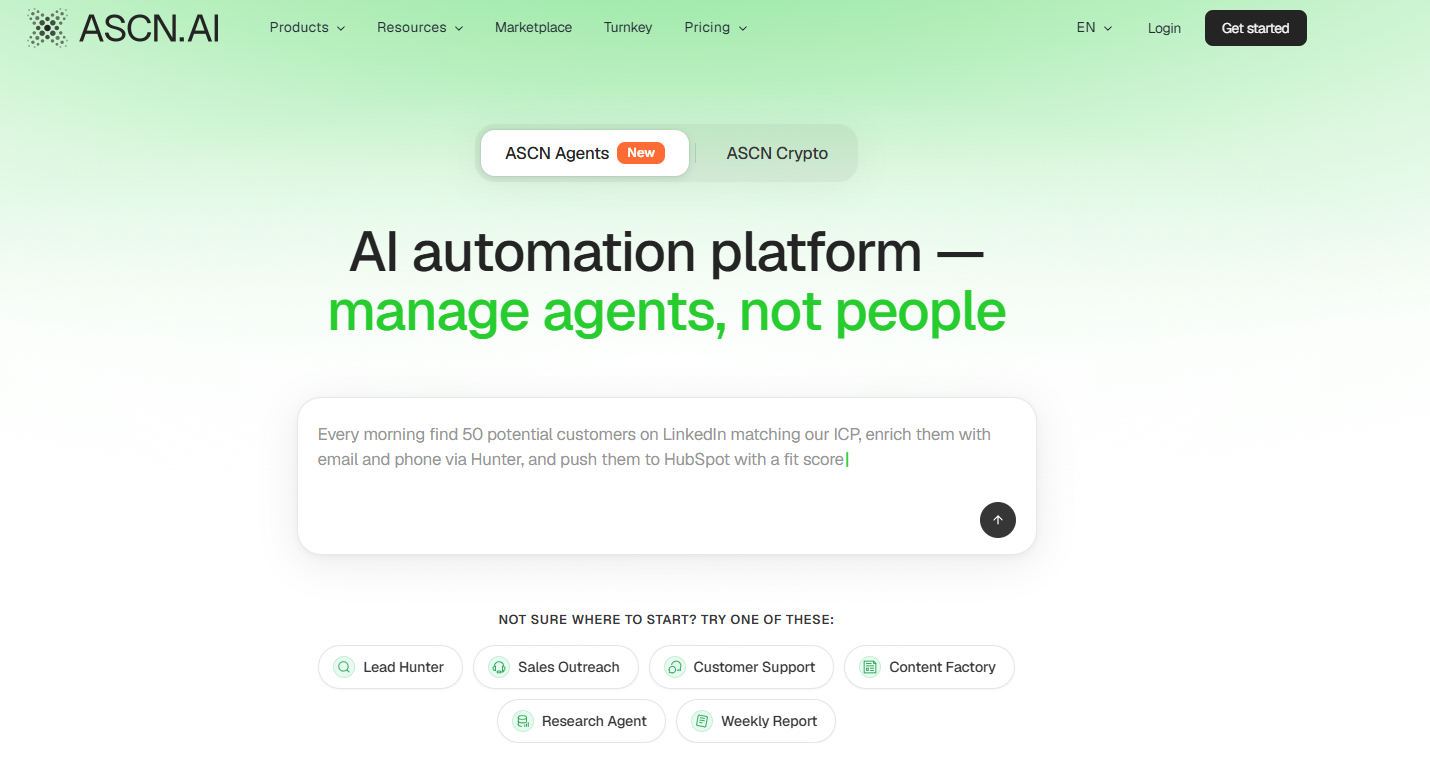
Killer feature: for sending custom proposals is complete autonomy: the agent initiates the lead, receives clarification on the data via telegram, creates the custom proposal, and sends it — all without needing to involve their supervisor until the very end. A set of automation templates are prebuilt and available for use.
Pricing: starts from 3900 roubles/month with several plans available depending on the AI agent selected.
Cons: Requires initial set up (although there are several pre-made scenarios). It is advisable to use a turn-key automation setup for complicated requirements.
Unique aspect: The special feature of the solution is its multi-agent model. One agent creates the document, the second agent follows up, and the third agent reports, allowing for an automated solution to be implemented via telegram.
How to use AI to create an effective commercial proposal: a step-by-step guide
Step 1: Gather the information needed to create your commercial proposal.
Data you will need to gather:
- Product details: What is this product? What pains does it solve?
- Unique Selling Proposition: Why should the prospective customer purchase from you rather than a competitor located down the street?
- Your selling price, timeframes and terms of your sale.
- Niche market segment where the specific customer is currently located.
- Business history (how have they done in the past).
Also have your Pricing List and a brief description of your businesses available for use, as some neural networks (i.e., Claude and GPT) work well when provided with these types of file formats.
Step 2: Write a request for your AI to provide you with assistance in creating your commercial proposal.
The request is basically writing a script that gives your AI a clear understanding of the action required. The clearer and more specific you are with your request, the better the response will be. Write the prompt in this format:
- Role: (You are a sales expert working within [Niche market].)
- Context: (We are a company selling [Product].)
Step 3: Generate the draft.
Give the command. In 30 seconds, you have the text. If it's off, tweak the prompt.
Step 4: Check the facts and have a managing partner review/accept edits.
Fact-checking is mandatory. Verify every number, relevance, tone, and structure.
Step 5: Create and submit final response to client.
Format the final version and send it. Don't forget about automation.
Examples of effective prompts for A
Prompt 1. Service CP (Marketing).
You are a professional marketer. We are an SEO company located in the [X_location] city. We focus on helping companies generate more leads through their company's marketing efforts, specifically through search engine optimization (SEO) practices. Our company targets businesses with turnover revenues of over $30 million.
CP for factory [Name]: The factory(s) want to generate more traffic and customers through online searches.
Outline (Example):
-Title (Your insightful question)
-Problem (No website traffic, competitors higher ranked than you)
-Solution (Turnkey SEO)
-Benefit(s) (Transparency, quantifiable results, etc.)
-Case Study (Traffic increases received)
-Pricing
-Call to Action (Get your audit)
-Tone - Trustworthy, calm, etc.
Prompt 2. Product presentation (ECOM).
You are a sales account representative in the ecommerce space. Product: Warehouse management system (WMS). Integration capabilities with Amazon, Ozon, & other e-retailers.
-CP for a store (Name – total number of orders for store = 3000). Pain Point (Assembly errors or excessive returns from customers due to assembly errors)
-Outline (Example):
-Title (Save You Money)
-Pain Point (Warehouse confusion)
-Solution (Intelligent or smart warehouse solution to improve overall efficiency & productivity)
-Benefits
-Case Study (Reduction in overall assembly time)
-Pricing
-Call to Action (14-day free trial of WMS)
5 Common Mistakes Creating CP's With Ai and Avoiding Them
Mistake #1: Doing Exactly What Is On The Screen
Remember, most AI is computing and gathering data through statistics. So, if you send your client a price on a CP that was represented by an AI system that does not exist or reflect cost as you know it, your prospects will have an estimated loss of the business. Always verify the price list you are providing to customers.
How To Avoid It: Always verify every figure or number.
Mistake #2: Failing To Personalize Content
Asking Ai to generate CP's is just throwing junk text together unless you specifically state the name of the company you want the CP for and the pain point that person/company has. As an example, CPs without any names or specific pain points have been opened approximately 34% less than they were with a name included.
How To Avoid It: Research the client for specific names and numbers before you create any content for them.
Problem #3: Weak Prompt
No structure leads to AI creating irrelevant content—long rambling, poem style.
Solution: Give AI a clear framework for use (role/context/task/tone).
Mistake #4: Ignoring Brand Voice
AI does not feel the client's brand; it may be stiff and create an inappropriate tone.
Solution: Specify in the prompt the style desired: "Short, Business manner (colleague)" and also provide the AI with samples of the client's brand voice.
Mistake #5: Leaking Client's Confidential Data
Public neural networks can learn from private data; do not upload client databases or financial reports to a public site.
Solution: Anonymize all data (removing everything that directly/indirectly identifies the client) or use corporate APIs/platforms like ASCN.AI.
Legal and Data Security Issues—Considerations for Calculating the Risk
Confidentiality – The problem with public models is that all data owned by companies are stored in the clouds of the model. Companies should use a B-to-B contract with NDA or Local Model (e.g. MS Copilot, ASCN.AI), or internal share /non-public shared models for your company's data.
Copyright – Generally, AI-generated text is owned by nobody (but if you alter it, you own it); don't just copy it.
Law – Data Privacy Laws (e.g. GDPR or legal equivalent) require you to have clients' consent to process their PII (personally identifiable information); generally, stating in your contract that you will be notifying them of how you will use their data is sufficient notice.
Frequently Asked Questions
1. Is it safe?
Yes, except if you upload proprietary company information to public chat rooms (where the AI works).
2. Will AI produce unique content?
Generally yes; however, the text structure may, in some instances, still be similar to another company's document. Add case studies to relate to your unique context.
3. Does AI replace management?
No. AI will only replace PDs (paper documents). Currently, AI can't replicate empathy or complex negotiations. The Manager's role will be changed to a hybrid of human + bot.
4. What's the cost?
Cost varies from $0 for testing up to $20 to $50 per month for an advanced version of the product. For corporate solutions, pricing will be greater.
5. Is it difficult to get started?
No, you can copy the prompts given in the referenced article, and be up and running in no time.
6. Where can I use AI?
Everywhere, from B2B (consulting, IT) to local real estate sales to educational content (courses).