



- Русский
- English
- Português
How to Build an AI Call Center with a Voicebot on GPT: A Step-by-Step Guide to Call Automation

You know what’s most infuriating? When you call a company at three in the morning and there’s nothing but silence. Or when there are hundreds of calls, but only two consultants on the line. And that’s it—game over.
I’m not talking about whether automation is necessary right now. I’m talking about how much money you’re losing when it’s absent. Seriously. An AI call center isn’t just a flashy image for a presentation. It’s exactly when this system takes over the entire routine: answering, recording, filtering, and working 24/7 without the human factor. A GPT-based voice bot understands natural speech, answers to the point, and doesn’t take vacations.
Over the last three years at ASCN.AI, we have helped hundreds of projects—from crypto to modern online stores—launch their call automation. The main rule is simple: if you are still manually answering every call, you aren't just losing time. You are losing customers. Because the winners aren't those with the best product, but those who respond the fastest. The benefits of AI for call centers aren't just catchy phrases for slides; they are concrete facts and figures:
- Reaction speed: 3–5 seconds per call for AI versus 2–8 minutes for a human.
- Processing cost: from $0.10 to $0.50 per call instead of $5–$15 for a human.
- Comparison of capabilities: a single AI agent is quite sufficient to process a thousand phone calls simultaneously.
- Availability: at any hour. No night shifts, no vacations, and no phrases like "I was on holiday when he called me."
Components of an AI Call Center
There are four main and essential components without which it is impossible to assemble a functioning AI call center. All the tools listed should be considered concrete technologies rather than theoretical discussions.
Conversational AI and Voice Applications
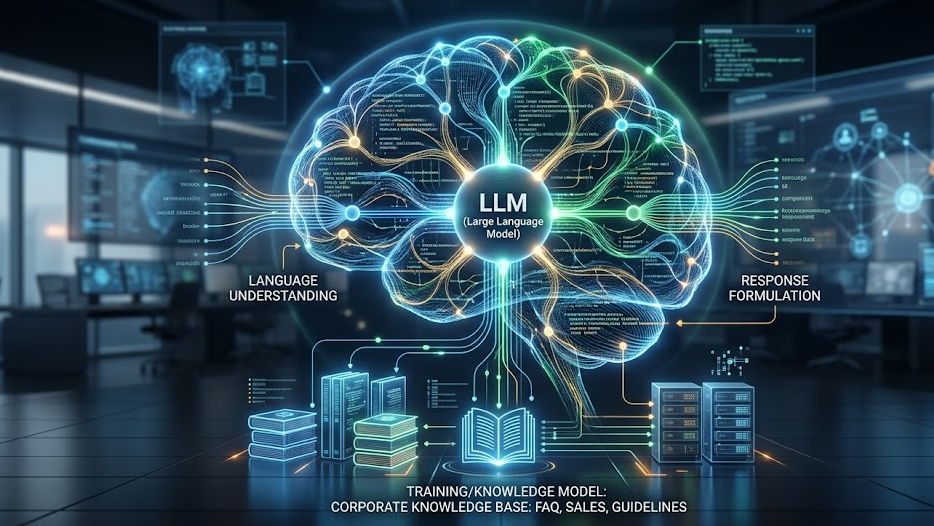
At the very heart lies the Large Language Model (LLM), which both understands text and formulates a response. Call centers primarily use GPT-4, GPT-3.5 Turbo, Claude, or specialized models like Rasa for internal closed systems. The model is trained on a corporate knowledge base: FAQs, sales scripts, and objection-handling regulations.
A voice application is the shell around the LLM that is responsible for the dialogue logic: maintaining context, switching topics, and escalating to an operator. In no-code platforms (ASCN.AI, Voiceflow, Dasha), this is visualized and built via a flowchart. For custom development, we connect via APIs and webhooks.
Speech Recognition and Synthesis Technologies
Speech-to-Text (STT) is the process of turning an audio stream into text. Leaders in this field include:
- OpenAI Whisper — approximately 95% accuracy on clean recordings, supports 99 languages, works locally or via API.
- Google Cloud Speech-to-Text — streaming recognition with 100–300 ms latency, adapts to accents and noise.
- Deepgram — optimized for real-time STT in call centers, with a minimum latency of 50–150 ms.
Text-to-Speech (TTS) voices the bot's responses. Popular services include:
- ElevenLabs — realistic voices with emotions, brand cloning, reaction time around 200–400 ms.
- Google Cloud Text-to-Speech — over 400 voices, using WaveNet technology for natural sound, supports streaming.
- Azure Neural TTS — integration with Microsoft, fine-tuning of intonations via SSML.
- Coqui TTS — open-source for those who prefer to keep data in-house.
For a call center, truly low latency is critical: if the time gap between a user's question and the AI's answer exceeds two seconds, the customer's composure is disrupted. A combination of Deepgram (STT) + GPT-4 Turbo (LLM) + ElevenLabs (TTS) with quality optimization yields a delay of about 1–1.5 seconds.
Integration with SIP, VAPI, and Other Communication Protocols
SIP (Session Initiation Protocol) is the standard protocol for VoIP calls. The AI connects to the telephone network via a SIP trunk to receive inbound and make outbound calls. Popular providers offering API services include:
- Twilio — API for making voice calls, SMS, and video; pay-as-you-go (costing only ~$0.013 per minute for an inbound call in the US).
- Vonage (Nexmo) — similar to Twilio, with a webhook system for event-driven architecture.
- Plivo — focused on scalability, suitable for many scenarios requiring high volumes.
VAPI (Voice API) refers to ready-made voice AI APIs, for example:
- Dasha AI — a platform for creating voice agents. Supports integration with Twilio and scriptwriting in DSL.
- Voximplant — a robust alternative with SIP and WebRTC support.
A full-fledged call center allows for integration with WebRTC (browser-based calls) and data exchange protocols (REST, WebSocket). Here’s how it works: the customer calls → via the Twilio SIP trunk, the call reaches the server → a webhook is triggered → the server runs STT (Deepgram), the recognized text is passed to GPT-4 → the response is synthesized via ElevenLabs → the audio stream returns to Twilio → the customer hears the bot's response.
In ASCN, this process resides in no-code blocks: you take a trigger called "Inbound Call," connect a "Speech Recognition" node, then an "AI Agent" with a prompt, then "Speech Synthesis"—and that’s it. Without a single line of code (ASCN.AI case study on the collapse of Falcon Finance).
Phone Call Automation via Voice Bot
A voice bot is a program that conducts a telephone conversation using speech recognition and synthesis. Unlike ancient IVRs with "press 1" menus, a modern bot understands natural speech. For example, if a customer wants to cancel order 1234 and informs the bot, the bot understands and processes this statement, checks all data in the CRM, cancels it, and informs the customer—all by itself, without human intervention.
Main functions of a voice bot:
- Lead qualification—the bot asks questions, evaluates them according to the script, and selects "warm" leads ready to talk to managers.
- Standard questions—orders, returns, and other inquiries.
- Reminders and confirmations—payment follow-ups, appointments, surveys.
- Transfer to an operator—when the scenario is non-traditional.
Why are GPT bots better than traditional rule-based systems? Here are the main things to note about them:
- Context is maintained throughout the entire dialogue.
- Phrasing can vary—a question can be asked in many different ways.
- Responses are generated in real-time, without the need to pre-write every single one.
- They are easy to train—you can use fine-tuning or RAG (Retrieval-Augmented Generation).
Indeed, there is a clear example: a bot in online education called a customer within the first minutes of receiving an inquiry, asked several questions, recorded the answers in the CRM, and scheduled a meeting. As a result, their conversion rate climbed from 12% to 31%—all thanks to reaction speed and the absence of human error.
Technologies for Speech Recognition and Synthesis
For a bot to be truly effective, high-quality STT and TTS are necessary. The customer must hear and be heard from the very first word.
- ElevenLabs — the undisputed leader in natural sounding voices. Cloning, emotional coloring, 200–400 ms delay.
- Google Cloud Text-to-Speech and Azure Neural TTS — true corporate-grade, reliable solutions that offer a wide range of voices and the ability to perfectly adjust intonation.
- Coqui TTS — an open-source solution for those who prefer to do everything themselves—hosting and controlling the generated information.
Automated Phone Call Processing with Neural Networks
- The call arrives at the SIP trunk (e.g., Twilio).
- Next, we convert speech to text using STT.
- We process the text with GPT according to a prompt based on a knowledge base.
- The resulting concise response is turned back into sound via TTS (ElevenLabs).
- If a transfer to an operator is needed, it is performed.
Within their algorithms, neural networks perform additional processes, including sentiment analysis (emotions), extracting key elements, and compiling brief reports for operators.
Online bank case (Deloitte): the bot handled 78% of all calls independently, saving the company $340,000 per year; processing time dropped from 6 minutes to 2.25, and NPS increased by 4 points over three months.
ASCN.AI case for a crypto project: the bot filtered out non-target inquiries, increased conversion from 3% to 8.4%, freeing up to 18 hours of manager time per week. A rewritten prompt doubled the conversion. Just like that.
Step-by-Step Instructions for Developing and Implementing an AI Call Center
The process consists of answering three questions:
- What are we solving? For example, 40% of calls are FAQs, 60% of leads are lost due to delayed responses.
- What metrics do we want to improve? First response time, conversion, CSAT.
- What percentage of calls can realistically be automated? Usually, 50 to 70 percent of calls are routine.
Using a task-setting checklist as an example:
- Problem: Operators spend 60% of their time on FAQs.
- Goal: Automate 80% of such calls.
- Metrics: First Response Time < 15 sec, CSAT ≥ 4.2, saving 25 hours per week.
- Constraints: Budget $2,000, timeframe—3 weeks.
Choosing Platforms and Technologies
Platform and technology choices should be based on the tasks at hand. Let's look at two main directions: no-code platforms (try it fast, affordable) and custom development (more complex, more flexible).
| Platform | Type | Launch Time | Cost | Flexibility | Target Audience |
|---|---|---|---|---|---|
| ASCN.AI NoCode | No-code | 1–2 weeks | $29–299/mo + API | Medium | SMBs, MVP |
| Voiceflow | No-code | 1–3 weeks | $40–400/mo | Medium | Simple scenarios |
| Dasha AI | Low-code | 2–4 weeks | from $500/mo | High | Complex dialogues, specialists |
| Twilio Studio + GPT API | Low-code | 3–6 weeks | Pay-as-you-go | Very high | Large-scale integrations |
| Custom Development | Code | 6–12 weeks | $10–30K + servers | Full | Unique projects |
Recommendations are simple: for small businesses—ASCN.AI or Voiceflow; for large companies—Twilio + GPT API; for unique projects—custom development.
Refining and Launching a Voice Bot (Example via ASCN.AI)
- Registration process on the platform and topping up the system balance.
- Creation of a knowledge base (scripts, documents, FAQ).
- Setting up the AI Agent with a query and selecting the model (GPT-3.5-turbo/GPT-4-turbo).
- Integration of STT (Deepgram, Whisper) and TTS (ElevenLabs).
- Configuring dialogue logic and escalation.
It is necessary to test recognition quality, the timeliness and quality of hints, speed, and response relevance. It should be published on a live number with recording and monitoring set up. The first prototype is a matter of 4–8 hours, provided the knowledge base is ready.
Integration with CRM and Phone Systems
This involves integration with modern CRM systems like amoCRM, Bitrix24, HubSpot, and Salesforce via REST API for deals, calls, and notes, as well as integration with phone systems like SIP with Asterisk, FreePBX, 3CX, and Twilio SIP trunks. Additionally, there is the capability to collect call event analytics in Google Analytics, Amplitude, and Mixpanel. Messengers: Telegram Bot API, WhatsApp Business API for customer confirmations.
Launch Testing and Validation
A/B testing of prompts, stress testing with noise and accents, and load tests. Monitoring key metrics:
- Resolution Rate (percentage of calls closed by the bot without an operator)
- Average Handle Time (AHT)
- CSAT — customer satisfaction surveys
- Escalation percentage
These data points will help improve both the knowledge base and the prompts step by step.
Operational Monitoring and Optimization
| Metric | What it measures | Goal | How to measure |
|---|---|---|---|
| First Response Time (FRT) | Time from start of call to bot's first response | < 10 sec | From call start to the first word |
| Resolution Rate | Percentage of calls completed without escalation | 60–80% | Calls without escalation / total calls |
| Escalation Rate | Percentage of transferred calls | 20–40% | Calls with escalation / total calls |
| Average Handle Time (AHT) | Average call duration | 2–5 min | Total time / number of calls |
| CSAT | Customer satisfaction | ≥ 4.0 out of 5 | Post-call survey |
| Intent Recognition Accuracy | Accuracy of intent detection | ≥ 85% | Manual sampling |
Examples and Best Practices for Integration
Case 1: Electronics Online Store
Task: 300–500 calls per day, 60% FAQs; 5 operators were overwhelmed, 15-minute wait time. Solution: a voice bot built on GPT-4 and ElevenLabs, with a knowledge base containing catalog info and FAQs.
Results: the bot handled 74% of calls, the average first response time was 6 seconds, CSAT 4.2, and savings amounted to ₽135,000 per month.
Case 2: Medical Clinic
Problem: patient intake via phone; administrators worked 10 hours a day. Solution: an AI bot integrated with electronic medical records with the ability to book slots. Result: 92% of all appointments booked by the bot, average time—2 min 10 sec, freeing up 7 hours of admin work per day.
Common Pitfalls and Prevention
- Overestimating AI capabilities: start automation with 50–60% simple requests and ensure a clear escalation path.
- Incomplete knowledge base: periodic audits, updates, and document version control are required.
- Feedback issues: analyze calls with low ratings and supplement the database.
- High latency issues: try using faster models, streaming TTS, and filler phrases to maintain engagement.
- Limited monitoring methods: use customizable notifications, scheduled analytics, and dashboards—visual and pressure-free.
Security and Compliance
Key risks:
- Leakage of personal information—mask all personal data, encrypt logs, or use self-hosted LLMs.
- Control exploits (prompt injection)—protect the system prompt and filter suspicious commands.
- Deepfake voice—warn customers, use synthesized voice, audio markers, and restrict access to cloning.
Critical regulations:
- GDPR: informing the customer and obtaining consent for recording, the right to erasure, and data minimization.
- PCI DSS: prohibition of voice-based payment data collection before certification; use of specialized services.
- HIPAA and SOC 2: encryption and auditing for medical and financial sectors.
Advice: consult with lawyers, include disclaimers in workflows, sign DPAs with services, and conduct regular security audits.
Frequently Asked Questions (FAQ)
What is a voice AI application for contact centers?
It is a system that processes calls, recognizes speech, analyzes intents, generates responses, and voices them—creating a dialogue with the customer without a human operator.
How does AI increase customer satisfaction?
- Response speed—3–5 seconds versus 5–10 minutes for a human.
- Consistency and quality of responses.
- E-commerce inquiries during non-working hours account for a significant 40%.
Now that 24/7 availability is ensured, it is worth asking—is it possible to integrate AI with existing infrastructure? Absolutely. We are ready to integrate with CRMs (Salesforce, amoCRM, Bitrix24), telephony (Twilio, SIP), analytics, and messengers.
What are the software and hardware requirements?
No-code platforms function via a browser, requiring a constant internet connection; custom development implies a server with at least ~4 physical processors, 8 GB of RAM, running Linux, using Python/Node.js with databases and audio libraries.
How to ensure security and confidentiality?
- Encrypt data "in transit" (TLS 1.3) and "at rest" (AES-256).
- Two-factor authentication and role-based access control.
- Logging and auditing.
- DPA agreements with API providers.
- Principle of data collection minimization.
- Backup and incident response.
Disclaimer
The information in this article is of a general nature and does not replace investment, legal, or security advice. The use of AI assistants requires a conscious approach and an understanding of specific platform functions.