



- Русский
- English
- Português
AI Agents for Online Schools: How to Stop Getting Bogged Down in Routine and Finally Scale Up

Imagine this scenario. To the left side of the image, a student is given an answer in under a second. To the right side of the image, the tutor has access only to a report that displays only clear analytics; thus, they do not have to sift through hundreds of unread messages. This may sound like something out of science fiction, but it is a reality that is already occurring today.
What exactly are AI agents for online learning and why do schools need them?
Let's take away any confusion right now. An Agent in an online school is simply an autonomous program. The Agent performs tasks independently of you; it answers questions from students, grades homework, sends reminders to students who missed due dates, and collects analytics data for the school owner.

Do not confuse the two. Unlike the old-school chatbots of the early 2000s that were strictly a "Press A to get B" type of application, AI agents understand context. An AI agent for online schools accesses the course material database instead of just providing pre-canned responses. AI agents are capable of completing tasks based on up-to-the-minute information.
To understand how AI agents are being used in business generally, let me give you the basics of the education model being the same as that of retail or customer service.
The core technology behind AI agents is language models. AI agents read your text, read your video transcripts, and read your PDF summary reports. The most important thing about AI agents is that they DO NOT create or generate answers from thin air! They are a digital worker that doesn't need to sleep, doesn't request time off, and does not suffer from burnout due to repetitive tasks.
The most important thing about AI agents for online schools is that they will allow for exponential growth of the school's student population; one Agent can have virtual conversations with 100 students at a time. Quickly respond to everyday inquiries and subsequently forward more complicated cases (with a ready-made summary) to your tutor.
Education Technology Ecosystem: Intent and key functions
- Automated grading of homework based on rubrics; checking for plagiarism; creating meaningful feedback.
- 24/7 student support — instant answers, course navigation assistance and feedback on deadlines.
- Analytics and reports for tutors — identifying students who may be struggling; providing milestones/indicators of at-risk of dropping out; and identifying students who may have "ghosted" the course.
- Learning track personalization — modifying the complexity of tasks according to an individual student's ability.
- Motivational scenarios — the combination of touchpoints set up for students when they start or return to the course after having been absent.
How AI agents change the lives of participants in the learning process
Scenario: A Student writes at 2 a.m. with the question: "How do I submit my homework?" A tutor who is supposed to answer this question the next morning may not respond because they didn't wake up until late. An AI agent would respond back to the student instantly. More than that, the agent would not give the student a generic response; it would actually provide the answer based on the module the student is currently working in and their previously submitted homework.
A large portion of the typical requests made to human tutors (80%) can be handled by AI agents. The result is that a group of 100 students can save a maximum of approximately 40 hrs of work from the tutor by utilizing AI. Although it can be difficult to teach, I created 3 videos that can help you learn how to teach this material. 86% of our group of 50 testers expressed that they were fine with these resources and not a burden; 3 participants chose to remove themselves from my subscriber list.
Furthermore, the agent was designed to allow users to easily navigate to a bonus via navigation links (as if they were using a GPS system to move about in a new neighborhood).
Helpful Hint: Avoid replacing anyone with an AI 100% (absolutely will not succeed); use an Empathetic Tone when creating your prompts so that your assistant can respond as though it were your friend rather than a government entity. Students can see through you when you are not genuine or sincere.
How an AI Assistant automates homework grading
Each assignment will take a teacher about 20-30 minutes to grade (until they grow tired). An AI Assistant can grade an assignment in two minutes and await human verification when appropriate. This means that your students' final fall homework is being graded; here are the four steps involved in grading by an AI:
- The Student will upload their assignment (a written document, code, slide show, etc.).
- The AI will learn about the assignment by referencing the rubric you created for the AI to evaluate the student's assignment based upon.
- Draft generation — the student will receive feedback on what they did correctly, where there were errors, and the way(s) they could improve their work. Any grades greater than 9/10 will have their feedback delivered right away.
- Tutor approval (optional) — In instances that the grade is below acceptable limits or if complexity of work exists, the tutor will receive a draft of feedback which can be approved or changed in just a few minutes.
The AI will not advise the student that they merely passed; they will explain to the student how they achieved the grade that they earned. The level of personalization in this feedback is unachievable via traditional means given the huge volume of student activity.
Another feature of agent assistance is its ability to check for potential plagiarism (against a database of past works) and to identify patterns of student error in assignments. For example, "Wow, 10 students made a mistake on this assignment; we need to re-record this lesson." The system will be able to identify this on its own.
AI agent — an indispensable assistant for online school tutors
Many times, a tutor will become a "grading machine." That is not a good use of their time. The focus should be on tutoring — building a relationship with the student, encouraging them to improve, and assisting them with more challenging situations. The agent will do the "grunt work" for the tutors.
As a good assistant for tutors, the AI agent can identify trends in student groups. For example, "These five students might withdraw from school; their turnover risk is high." It also collects feedback from students after each lesson (NPS) and provides real-time reports for the producer.
It may sound a bit mercenary, but people shouldn't be using their intelligence to simply transfer data from Excel to a report.
With the AI agent, the tutor is able to have an organized, well-structured list rather than sifting through a dozen or more chat messages to find out what each student needs. For example, "Call Masha; she is having a rough week. Check Petya's code." The amount of time saved is incredible.
Automation and personalization of the learning track with AI
Adaptive learning has become a bit of a buzzword. However, it is essentially using a system that customizes itself to the particular student's strengths and weaknesses, rather than expecting the student to adapt to the system. AI project optimization technologies allow this capability, even in the mass market. Learning track automation through AI operates like this: the AI agent will track where you pause or replay a video, or where you take a test for the third time. It then provides you with additional resources to help with areas of error or skips the boring video/block altogether, based on data collected from your actions.
It's a "smart navigator". You can tell the AI agent is tracking your progress, so you do not feel alone in your online school experience.
Online school efficiency: Comparison of efficiency before and after the implementation of AI agents
By implementing AI agents, the business model of online school has changed. Manual processes have become automated processes. The benefits of this change include saving money, improving efficiency, and increasing the speed of doing things.
| Process | "Traditional model" (before implementing AI) | "New model" (after implementing AI agents) | Savings (time/money) |
|---|---|---|---|
| Student support | Tutor responds manually (average ~10 mins per support request, day only) | Tutorial queries received instantaneously; 24/7 AI agent provides 0 mins of routine support | Up to 40 hours/week per group of students (100 students total) |
| Grading homework | 20-30 minutes per assignment through manual process | 2 minutes per assignment for AI + 2 minutes (validation time) | 80% decrease in time; 5 times as many projects processed |
| Performance analytics | Manual collection of data each week; requires 3-4 hours | Pre-built performance analytics dashboard in real-time | 12-16 hours of time each month |
| Student onboarding | Generic template email communication; manually mailed | Personalized student onboarding scenarios based on activity data | 50% faster time to complete; 30% increase in course completion |
To clarify once more: an AI agent does not replace the tutor. An AI agent provides the tutor with a way to eliminate routine tasks so that the tutor can work on the more complex ideas and relationships that an AI cannot provide for you.
Technical implementation and LMS integration
An AI agent does not only supply written text, but also supports the generation of written text (if it only provided for the generation of written text, it could create an instance where an AI will lie to you). An AI agent uses a RAG (Retrieval-Augmented Generation) approach. The procedure consists of the following steps:
- A Student coming in with: "How to calculate ROI."
- The agent searches your PDFs, lesson transcripts, and instruction on how to calculate ROI.
- The agent finds the exact text with the formula and then provides an answer specifically based on what he/she has found.
This eliminates any possibility of hallucinations if AI were to produce a false answer, as the agent will state: "I don't know, I will ask a human," if it doesn't find that data in the database. To train the system, upload all of your training material into the database: scripts, presentations, FAQs, etc. The more complete your database base is, the smarter your "employee" will be.
Platform Integration: No-code solutions vs. Custom development
There is a trade-off between using a no-code solution versus custom development for platform integration.
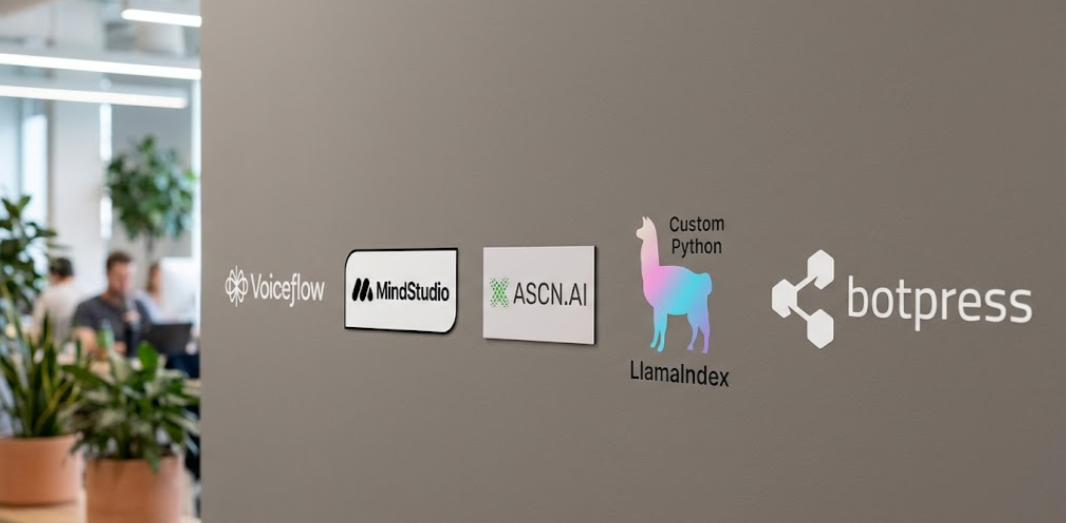
No-Code Platforms (n8n, Voiceflow, Botpress, ASCN.AI):
- Speed: Days to Launch.
- Cost: Service fees range from Free to $200-$500 a month (subscription + tokens).
- Complexity: You do not need a programmer. All visual building.
- Purpose: Support, Simple graded assessments, Chatbots (support).
ASCN.AI has more than 100 workflow automation templates that can be modified for your business needs, and integrate with Telegram, Gmail, Notion, all through 1 click (no coding required).
Custom Development (LlamaIndex, LangChain + Python):
- Speed: Weeks to Months.
- Cost: $2,000 to start + servers.
- Complexity: You will require a developer/team of developers.
- Purpose: Analytics that are unique to your organization (complex/non-standard ways to grade students).
With all of the above, the bottom line is simple: If you are a small school or currently in a growth phase -- go with no-code solutions.
Tool Comparison Table
| Tool | Complexity | Cost | Best Case Use Cases |
|---|---|---|---|
| Voiceflow | Low | Up to $150/mo | Chatbots, FAQ, simple scripts |
| MindStudio | Medium | Starting at $29/mo | Agents with integration and more complex functions |
| ASCN.AI | Low to Medium | From $0 (limitations) to implementation package | Pre-made templates designed for full cycle business automation |
| Custom Python (LlamaIndex) | High | Starting at $2,000 + server | Functions that are unique in nature and have deep levels of analytics |
| Botpress | Medium | Up to $500/mo |
Open source chatbots that are flexibly developed |
Case Studies: Real Life AI Implementation Examples in Education
The statistics tell the story; the company implementing AI could take new hires from two weeks down to five days to acclimate.
Example 1: Language Courses – AI Role Play as a Conversation Partner
An English language school introduced a conversational agent. The student converses with the AI as though the AI were an employer or salesperson. While the student converses and has a chance to practice as needed, the AI listens and gives suggestions for grammatical and pronunciation corrections. Outcome: No fear of conversational judgement. Extensive opportunity for practice without fear. Purchases increased by 28%.
Example 2: IT Schools – AI Code Reviewer
The programming school experienced a 4x increase in total transactions through a reviewer agent. The reviewer agent does not only identify incorrect programming code but also communicates to the student programmer why their code is incorrect and outlines the correct way to write the code. What previously required 40 minutes to provide mentor confirmation of grading now only takes 5 minutes; however, the quality has not decreased, and the time and speed to process have increased.
Example 3: Business Training – Onboarding New Employee
Companies with their own internal platform. When a new employee has a question related to obtaining a sick leave form, they can ask via voice, "Where do I get a sick leave form?" In ten seconds, the assistant can respond based on the pre-defined query. As a result, there is no delay waiting for an HR representative or searching for the information in a Wiki; the employee can get the response immediately. Five-Day Adaptation Time.
Risks, ethics, and the future of AI agents in education
The role of AI agents in Learning should be considered in regards to ethical considerations of risk. Some of the most likely causes of failure in Learning will be the use of personal data or subject matter files without limits to access information (risk from All Permissions). Under the same logic as crypto, a greater than required access method may lead to information leaks because of too many keys. Consider limiting your agent's access to only course materials and a Frequently Asked Questions page.
Removing humans from agents creates issues with Engaging Learners. Routine tasks can be performed by an AI; however, Crisis Management requires a human touch. For instance, if a Learner writes "I can't stand it anymore" it would be better for the Learner to work with a mentor than an agent who provides a one size fits all response. Have clear processes for transferring cases from AI to humans where the Learner's case is complex.
AI agents need to have an up-to-date knowledge base; if not, they will lose their value as an agent. You should have an individual who updates the knowledge base once a month. Learners should be given an opportunity to provide their feedback on agents: for example "Was this response useful?". Agent functionality can be refined by modifying the prompts provided to it.
Predictions: What will learning assistants look like in 5 years?
Visual presence and empathy: Learning Assistants will have a strong visual presence. Agents will be able to provide more than text responses. Cameras will allow the agent to provide a "tutor" feel and give Learners the flexibility to communicate with the agent in the manner they prefer (example: video, audio, or text). As a result of this technology, Learners will have less "loneliness" in distance Education.
Adaptation for Psychological Reasons: Artificial Intelligence Agents will begin to read emotion in a student (e.g. "Student is angry." "Student is demotivated.") and will then deliver materials in accordance with the mood of the student.
Multi-agent Teams: One AI Agent will check the code; a second will handle theory; a third will provide motivation. All three agents will be able to talk to each other and pass information between each other.
Career Pathing: AI not only will teach; AI will also search for internships for particular students by reviewing their resume and other information. The school will become an HR agency as well.
AI agent implementation checklist in 1 week (Roadmap)
- Day 1: Audit — Write down 10 questions you get asked most often and 3 tasks you do that annoy you the most.
- Day 2: Knowledge Base — Write answers to above in 1 file (Notion/Doc). Add scripts to file.
- Day 3: Platform — Register for No Code Platform (ASCN.AI or similar). Choose a template.
- Day 4: Prompts — Write a role for your agent "You are an Aide. Respond in a friendly manner. If you do not know the answer, please contact a human."
- Day 5: Testing — Give 3 loyal students access to the agent and listen to what they say.
- Day 6: Integration — Connect the Agent to Telegram or your website.
- Day 7: Launch — Turn on for everyone. Monitor logs for the first few days.
Frequently Asked Questions (FAQ)
How much will it cost to develop an AI agent for my course?
There is a wide range of costs in developing an AI Agent. If you begin without coding through multiple No Code Platforms (e.g. ASCN.AI or VOICEFLOW), you can start with free or pay $50-$200/month. If you choose to develop complex custom development (integrations/ multi-agents), the implementation costs will range from $500-$2000, plus cost of tokens. However, for the majority (80%+) of schools, the majority of No Code Solutions will be more than sufficient and pay for themselves within one month.
Is it necessary to have programming skills?
No. Modern platforms operate similar to Lego sets. Choose a template, upload your PDF of your Course, develop your scenario and you are finished. If you want to develop a Bot for your Business yourself, you will find that NO Code is required. ASCN.AI Provides 100% of your Task templates for every requirement. All work can be done in a Visual Interface. You will only require a programmer for deep integration into legacy systems.
Can an AI Agent completely replace a Teacher?
No. An AI Agent will perform the repetitive work (such as grading, responding to FAQs, providing reports) with the teacher providing motivation, empathy and more importantly analyzing and evaluating complex scenarios. The hybrid model will be the most efficient; AI will handle the routine and Teachers will provide meaning. This is the future of our industry.
How does the Agent know what context it is responding to?
The agent uses a RAG (Retrieval Augmented Generation) to find information prior to responding. The agent does not recall from general training, but rather uses the uploaded Knowledge Base to “search.” This eliminates the chance of hallucination.